Container rates remain elevated, as Middle East conflict still uncertain
Share

Share
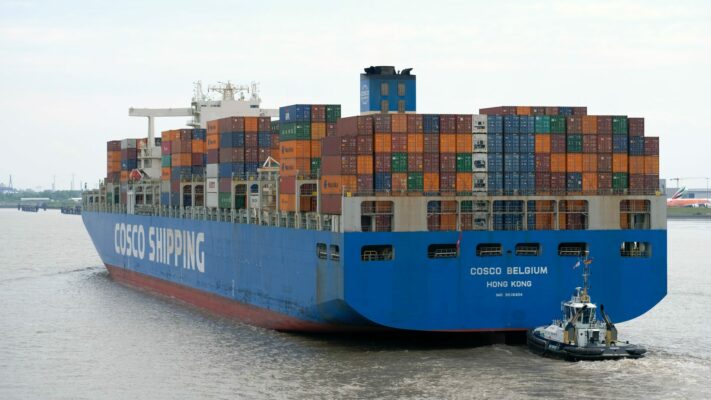
The Drewry World Container Index (WCI) ticked up one per cent to US$2,309 per 40-ft container for the week of April 6-10, mainly driven by rising rates on the Transpacific and Transatlantic trade routes.
Spot rates from Rotterdam to New York jumped 25 per cent to US$1,968 per 40-ft box this week, breaking the usual trend of stability in the Transatlantic. The primary catalyst for this increase is a 13 per cent month-on-month contraction in available ocean capacity for April.
On the Transpacific route, spot rates from Shanghai to New York increased seven per cent to US$3,671 per 40-ft container, while those to Los Angeles rose nine per cent to US$2,910. Maersk is seeking U.S. regulatory approval to waive off the 30-day notice period and to introduce an emergency bunker surcharge, citing elevated and volatile fuel costs amid tensions in the Middle East. The proposed surcharge is US$200 per teu for head-haul and US$100 per teu for backhaul dry shipments. With carriers continuing to push for rate increases, Drewry expects spot rates to increase further in the coming weeks.
Spot rates on the Asia–Europe trade declined this week, with those on Shanghai–Genoa falling three per cent to US$3,420 per 40-ft container and on Shanghai–Rotterdam decreasing nine per cent to US$2,308. According to Drewry’s Container Capacity Insight, only one blank sailing has been announced for next week on the Asia–Europe trade, indicating relatively stable capacity.
A temporary two-week ceasefire in the Strait of Hormuz has allowed some shipping activity to resume, but the situation remains uncertain. Vessels are required to coordinate transit with Iranian authorities, and since no clear guidelines are available yet—along with proposed transit fees—carriers are proceeding cautiously. The immediate focus is on clearing ships already stuck in the Persian Gulf rather than sending new ones in.
At the same time, disruptions to oil flows, which account for nearly 20 per cent of global supply through the strait, are ongoing and may take months to fully normalise. This continues to squeeze bunker fuel availability, which is expected to keep freight rates elevated in the near term.
Leave a Reply