Air cargo adapts to geopolitical shifts, technology and new opportunities
Share

Share
Like all modes of transportation, air has undergone several transformations over the past decade. As a vital part of the global supply chain, geopolitical disruptions, technology and infrastructure needs have all influenced how cargo is transported by air.
During a panel discussion at the CITT’s annual conference in Calgary, moderator Allan To of Supply Chain Canada West said supply chain decisions are no longer being made purely based on cost or speed, but rather as a response to geopolitical realities and regulatory adjustments that follow.
He also pointed out that air cargo demand grew 3.4 per cent in 2025, which outperformed projections.
Disruption reshapes cargo networks
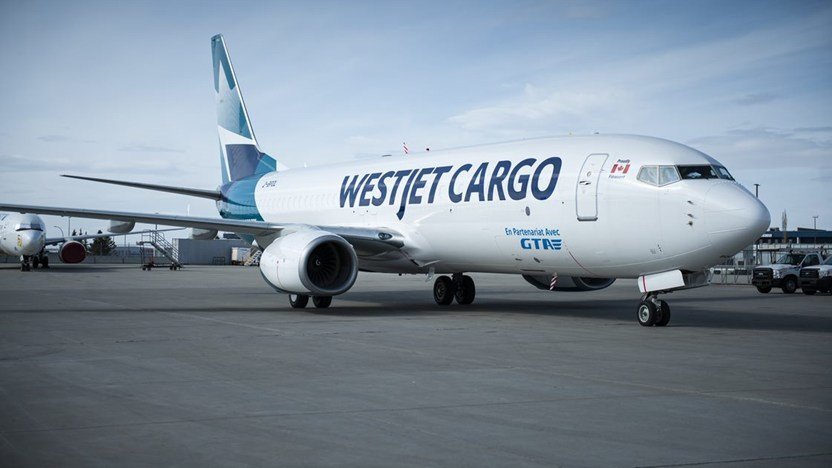
Julius Mooney, director of commercial for WestJet Cargo, said U.S. tariff announcements have forced an immediate network overhaul because his company’s operation is based on passenger-route capacity.
“The last 12 to 18 months, the tariffs in February, March last year with some big announcements coming from south of the border immediately meant that we had to change our network significantly,” he said. “Thirty per cent of what we call ASM — available seat miles — were pointed between Canada and the U.S. Thirty per cent of that was cut because of what happened in the U.S. So, significant capacity reductions.”
Less passenger volume between Canada and the U.S. means less opportunity to move cargo for WestJet, forcing the company to reevaluate its approach.
Fuel costs have also had an impact on air cargo, as have airspace closures over Russia due to its conflict with Ukraine.
“The geopolitical situations in the last 18 months have definitely not been kind to us.”
– Julius Mooney, director of commercial for WestJet Cargo
Air Canada Cargo has faced similar challenges, though Ben Speed, commercial manager – Western Canada for Air Canada Cargo, believes there could be an upside to the passenger-demand pullback between Canada and the U.S.
“We may be looking at exporting more that’s going to have to go over an ocean, so there’s more opportunity for us in the airline sector,” he said, also echoing Mooney’s sentiment on fuel prices and Russian airspace restrictions.
“Overflying Russia due to sanctions really impacts our ability to fly to Asia from Eastern Canada because they go transpolar. Those flights either have to be cancelled or we have to find tricky ways to get them there, which often requires carrying more fuel — and that can impact our payload.”
Technology and digital transformation
Technology is another area where airlines are looking to expand their capabilities.
At WestJet, investments have been made into online booking platforms, such as Cargo One, Cargo AI and WebCargo, which Mooney compared to Expedia for airlines.
“We’re trying to develop payment solutions online for consignee-driven customers, whereas larger customers use direct billing through IATA cast billing,” he said. “We can look at demand on specific destinations and specific days of the week and adjust our pricing accordingly to try and fill gaps in our network.”
On the airport side, AI-enabled cameras are being used on the cargo apron at Calgary International Airport to track turnaround efficiency.
“It can track when the plane arrives, when it’s on block, when the doors open, when the loader arrives — creating a heat map so carriers like CargoJet can track their turnaround efficiency,” said Sarah Barton, cargo air service development manager at the Calgary International Airport.
Barton does note that there remain limitations to what this kind of data can accomplish.
“Is it going to solve everybody’s problems? No, but it gives visibility and reporting,” she said. “It’s used more for safety and efficiency insight than to force faster unloading — you can’t move 10 minutes faster unloading an item.”
Alex Lowe, director of e-commerce, cargo and aviation real estate at Edmonton International Airport, said North America could soon see its first scheduled cargo drone route, which would operate Monday to Friday, every hour on the hour, carrying packages on a prescribed route.
Lowe said his team took the lead on the regulatory side, submitting a rules and hazards assessment to Transport Canada and NAV Canada, which ultimately launched the project. The first phase of the project will include 25 successful test flights and a second stop at a First Nations medical clinic during Phase 2. Lowe said the Middle East is a global leader in drone deliveries, with Amazon, UPS and Stellantis all major investors.
Canada’s geographic advantage
With Canada sitting north of the world’s largest economy, across the Atlantic Ocean from the European Union and the Pacific Ocean to Asia, Mooney said Canada should emulate a model used by Dubai of building distribution infrastructure around a free trade zone rather than serving only domestic demand.
“If you look at pictures of Dubai 20 years ago, it was a few skyscrapers in the desert — look at it now,” he said. “This was primarily driven by free zone activity…100 per cent foreign ownership, no duties, everything came in bonded, then distributed globally. Dubai was built on the port and the export connectivity, not on servicing the local population.”
Mooney said Calgary and Edmonton can employ this same model, and that it would attract foreign investment and establish distribution hubs.
Lowe said that, although Canada lacks the population scale of other regions, it does have valuable trade infrastructure and that a foreign trade zone policy would be more competitive globally.
He also touted the idea of cargo aircraft technical stops.
“If you take the largest airplanes in the world and fill them with cargo instead of passengers, on a long route like Shanghai to Chicago, that plane can’t make it in one stop the way it could with passengers — there’s a technical stop somewhere to pick up fuel,” he said. “That’s an import and export opportunity…a big opportunity to better utilize inland ports and the infrastructure that’s there.”
Speed said expanded bilateral air agreements that allowed new routes west of Ontario were another important step in the right direction.
“Etihad Airways is going to start flying Calgary to Abu Dhabi in October, but only because they opened the bilaterals with that condition. That was a huge win for Western Canada,” said Speed, adding that Alberta is a big part of that win. “Alberta’s population is growing, our disposable income is now higher than in B.C., manufacturing exports were up 34 per cent last year. Air cargo deserves an equal seat at the table in these discussions — rail and marine have always had a louder voice.”



Leave a Reply