Canada’s Western Gateway helps connect Southern Alberta businesses to the world
Share

Share
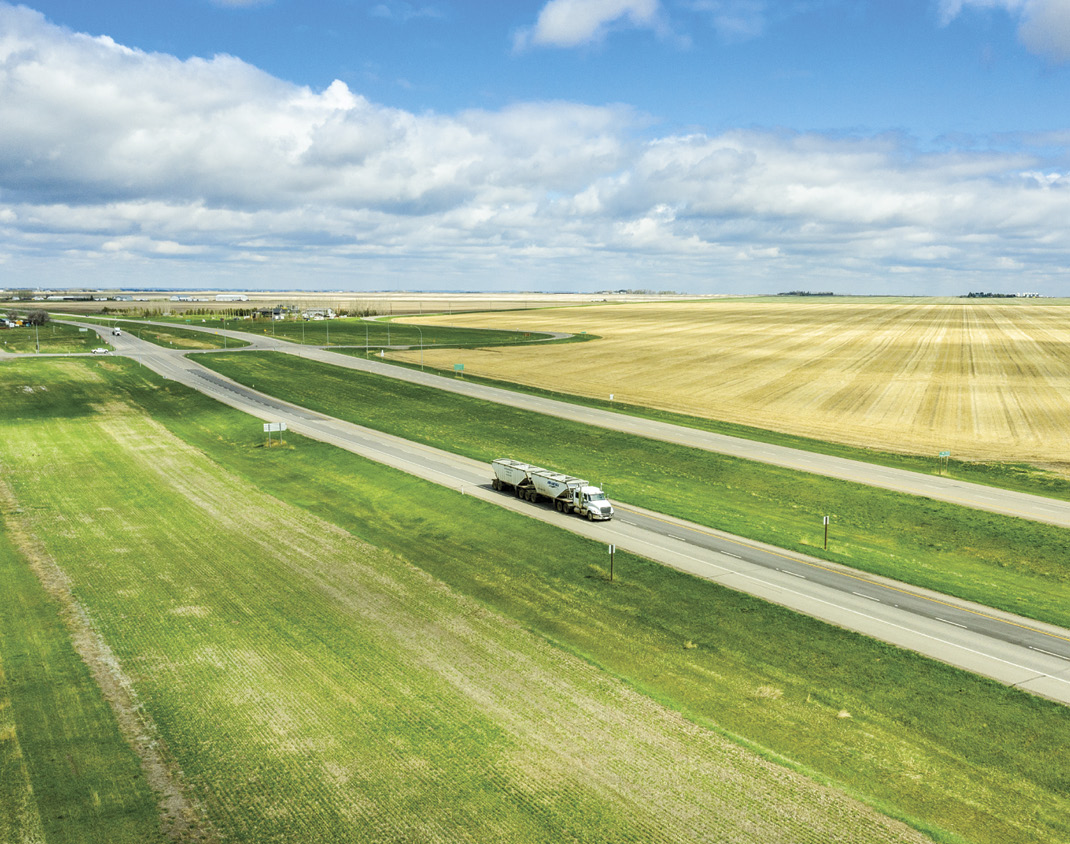
Strategically located in Canada’s premier food corridor, a new initiative is shining a light everything Southern Alberta has to offer.
With several logistical advantages, Canada’s Western Gateway is a distribution hub that boasts an extensive transportation network including air, road and rail, and has direct access to marine through Canada’s largest port in Vancouver.
Inside Logistics recently sat down with Brady Schnell, cluster development manager, and Rylan Howard, industry engagement coordinator, and talked about what Canada’s Western Gateway means to the region, how it benefits businesses and Western Canada and what the future holds for the project.
Inside Logistics: Let’s start with the basics. For readers who may not be familiar, can you give us an overview of what Canada’s Western Gateway is, how and when it started and why it’s important to Southern Alberta?
Brady Schnell: Canada’s Western Gateway is a three-year cluster development initiative led by Economic Development Lethbridge in southern Alberta. We receive funding support from Prairies Economic Development Canada, and at its core, it’s a regional partnership focused on strengthening transportation, logistics and warehousing along Highway 4 — from Lethbridge to the Coutts border crossing with Montana.
There are seven municipal partners involved: the City of Lethbridge, Lethbridge County, Warner County, Milk River, Warner, Coutts and Stirling. These communities came together in 2023 and recognized that transportation and logistics are critical to the region’s economy. The project officially launched in April of last year, and Rylan and I were hired in 2025 to begin delivering the initiative.
We’re still very early in the project, so building awareness of the Gateway and our objectives is a major focus right now.
IL: That’s interesting how new the initiative is. What types of products move through Southern Alberta today?
Rylan Howard: Southern Alberta is unique in that it has the most irrigated farmland in Canada and is known as the country’s premier food corridor. As a result, we see a lot of agricultural products moving through the region, including grain and potatoes, as well as manufactured food products like sugar and French fries.
Beyond food, there’s also movement of construction materials, raw energy inputs and manufactured goods.
Schnell: One thing that surprised me when I started was learning that Southern Alberta is a world leader in mustard seed production. We also have sugar beets out of Taber, cattle and beef products and all the feed and crop inputs that go along with that. There’s a tremendous amount of goods movement tied to food production.
We have McCain Foods operating a massive facility here, and PepsiCo’s Frito-Lay has a manufacturing and distribution operation in Lethbridge that serves all Western Canada. Six different Lay’s brands are produced and distributed from here, supported by a private fleet. Companies locate here because the inputs, infrastructure, and workforce are in place.
IL: Online, the Gateway is described as a “high-performance corridor.” What does that mean in practice for shippers, carriers and manufacturers?
Schnell: It’s more than a tagline. We have more than 200 companies operating in transportation, logistics and warehousing, employing over 3,000 people. High performance means fewer bottlenecks, lower congestion, predictable travel times, excellent road infrastructure and terminals with available capacity.
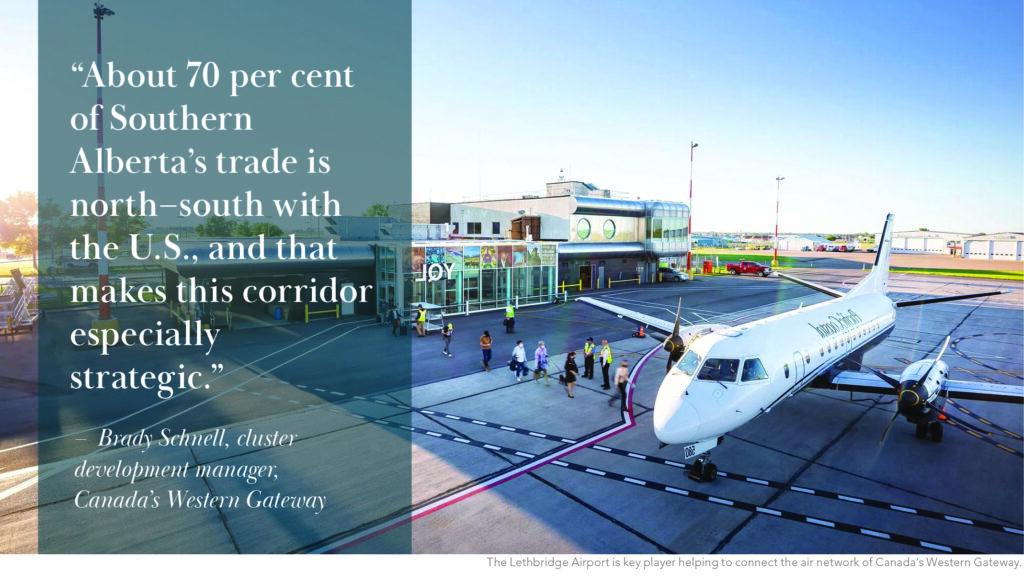
We’re not Vancouver, Calgary, or Toronto, and that’s actually an advantage. We have room to grow. We also benefit from the Coutts–Sweetgrass border crossing, which is Alberta’s only 24/7 crossing. About 70 per cent of Southern Alberta’s trade is north–south with the U.S., and that makes this corridor especially strategic.
IL: Given current trade tensions and tariffs with the U.S., have you seen any impacts so far?
Schnell: Yes, there have definitely been impacts. Some manufacturers are seeing reduced orders or delays, and we’ve seen inventory build up in yards as a result of uncertainty. I recently visited Great Falls, Montana, and spoke with a pasta manufacturer exporting to Canada — they’ve been affected as well.
Unfortunately, manufacturers and consumers tend to bear the brunt of these trade disputes. That said, we’ve also seen resilience. Companies are pivoting, finding new partners and adapting. At this stage of the project, our focus is on listening and understanding how businesses are being affected.
IL: The Gateway brings together multiple municipalities and partners. How does that collaboration work, and why is it so important?
Howard: No single municipality or business can solve corridor-level challenges alone. We align municipalities, industries and organizations around shared priorities instead of working in silos.
We’ve also seen strong collaboration beyond our region. For example, at our October event, we partnered with organizations like the Canadian Logistics Association [CITT], PTAC [Petroleum Technology Alliance Canada], PMTC [Private Motor Truck Council of Canada] and AMTA [Alberta Motor Transport Association]. There’s growing interest in Highway 4 across North America, which has been very encouraging.
Our approach aligns with Prairies Economic Development Canada’s goal of growing the prairie economy as a whole, and with Economic Development Lethbridge’s philosophy of “Brighter Together.” A rising tide floats all boats.
IL: From a national perspective, how does the Western Gateway complement Canada’s other major corridors and ports?
Schnell: A lot of goods moving north–south from Edmonton and Calgary pass through Lethbridge on their way to the U.S. But we’re also part of the east–west network.
Lethbridge is connected by both road and rail to the ports of Vancouver and to eastern markets like Winnipeg, Toronto and Montreal. We’re also located on the CANAMEX corridor, linking Canada, the U.S., and Mexico. Food, agricultural products and energy products moving south are a major part of that picture.
IL: What specific challenges was the Western Gateway designed to address?
Howard: Anything that makes trade more expensive or creates friction – whether that’s infrastructure gaps, labour availability or interprovincial trade barriers. By aligning businesses and municipalities, we create a support ecosystem that helps turn challenges into opportunities.
Schnell: From an investment attraction perspective, a big part of our work is ensuring communities are investment-ready. That means land availability, zoning, permitting and access to infrastructure like rail.
For example, while the CPKC mainline runs through Lethbridge, the city owns the industrial rail spurs. We’re asking questions about future rail access, capacity and whether additional spurs or improvements will be needed to attract investment.
Economic Development Lethbridge is also wrapping up a regional movement-of-goods study that looks at volumes and future needs. One question raised is whether Lethbridge could benefit from a third-party rail switching service. These are the kinds of conversations we want to have proactively.
IL: Looking ahead, how do you define success for the Western Gateway?
Schnell: Success includes identifying and marketing investment-ready land, mapping the entire logistics and transportation ecosystem and producing recommendations that help communities prepare for growth.
We also want to support small and medium-sized businesses, engage directly with industry and address workforce challenges — particularly in truck driver training. We’re already working with local training providers and institutions.
Ultimately, success means attracting new investment and creating jobs. If we can help companies grow and bring employment to southern Alberta, we’ll have achieved our goal.
IL: For shippers, carriers, manufacturers or municipalities that want to get involved, what’s the first step?
Howard: They can contact me directly at (403) 635-2670 or by email at ryland@chooselethbridge.ca. People can also visit canadaswesterngateway.ca or reach out through LinkedIn, Instagram or Facebook.
Schnell: We genuinely want to hear from industry. Whether you’re a sole-operator truck driver or a large fleet, connecting directly with us helps ensure we’re focusing on the right priorities.






Leave a Reply