New CITT certifications aim to upskill Canada’s logistics workforce
Share

Share
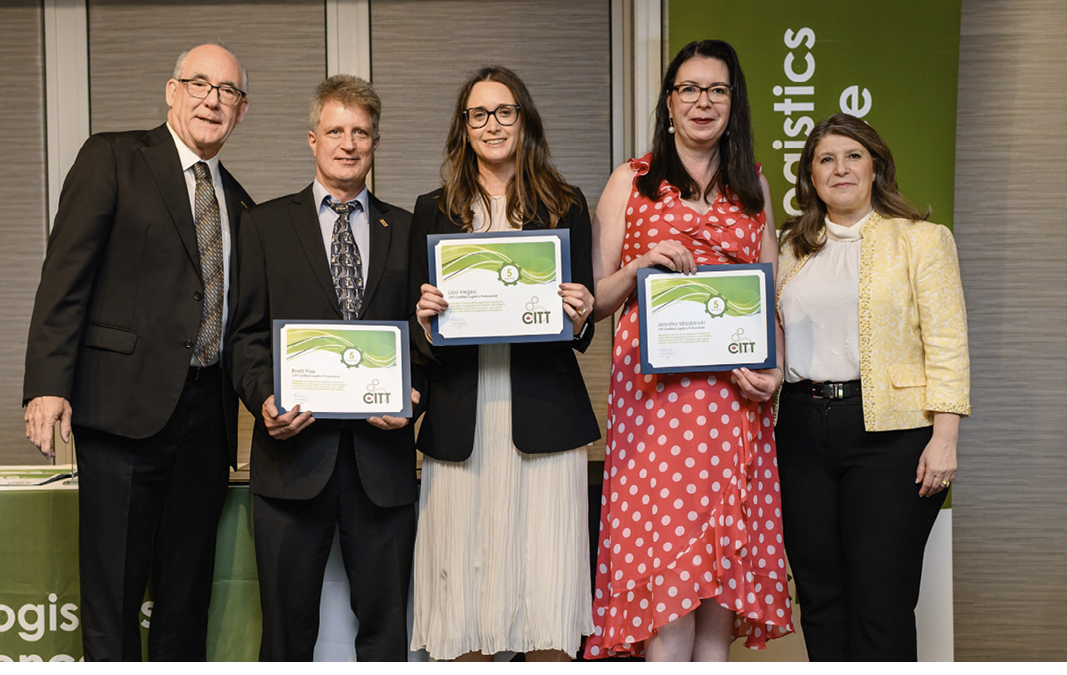
As Canada’s Logistics Association, CITT has long provided professional designations to industry members looking to enhance their skills. While the logistics and supply chain sector continues to evolve, so has CITT and its certifications, helping the logistics community thrive in 2025 and beyond.
To help meet the needs of today’s logistics professionals, CITT has restructured its professional designations, replacing the CITT-Certified Logistics Professional (CCLP) with a two-tiered system: a new foundational CCLP and an advanced Certified Canadian Logistics Management Professional (CCLMP) designation.
The change is the result of regular competency reviews that revealed the need for two distinct professional profiles within the former single CCLP designation.
“One thing that became clear was that the competencies we certified actually formed two separate profiles,” said Pina Melchionna, president and CEO of CITT. “The first is a more logistics- and transportation-focused profile, with the skills and knowledge of those in operational roles. The second builds upon that but also involves more strategic oversight, advanced logistics abilities, as well as leadership and managerial competencies.”
CCLP (early- to mid-career)
By providing a two-tiered certification system, those who have just entered the industry or are in the early stages of their careers have better access to CITT’s professional designations.
“The new CCLP has really been designed with these people in mind. It teaches the functional competencies people need to succeed as they move through the middle of their careers and go up the ladder,” said Melchionna. “It lets them build and certify their abilities through CITT—Canada’s Logistics Association—and leaves the more senior-level competencies for when they are later in their career.”
The new CCLP is designed to focus specifically on logistics competencies, without general business requirements. It certifies early-career professionals in areas including transportation, distribution and integrated logistics, law and compliance. There is a streamlined path to acquire the CCLP designation that includes five courses, with no electives or business education required, and it is a prerequisite to the CCLMP designation.
“We’ve removed some of the more general business knowledge competencies, as we found they were not as relevant or in demand for professionals in early- to mid-career logistics roles,” said Melchionna.
CCLMP (late- to advanced-career)
The second tier, CCLMP, integrates modern competencies such as technology adaptation and sustainability to reflect the evolution of the logistics industry.
“Technology has evolved dramatically. Being able to adapt to technology and understand how it impacts your organization has become far more important, even in the last decade,” said Melchionna. “Sustainability is a second major area. In the last decade, it’s become crucial for leadership roles and an important component of organizational strategy.”
Building on the foundations learned during CCLP certification, CCLMP focuses on business management, advanced logistics, technology, leadership and sustainability.
Those who previously held the CCLP designation have the option to upgrade, while those currently in the middle of a certification are being supported individually by CITT to find the best way forward based on their level of education and professional experience.
Melchionna underscored the changing landscape of the logistics sector since the pandemic, noting it has become more strategic and more important for organizations—demanding leadership-level certification.
CITT’s new progressive learning path—offering CCLP, CCLMP and micro-credentials—helps address this growing need.
“CITT offers a Canadian Transportation and Distribution Logistics micro-credential, which is appropriate for those at the very beginning of their career in logistics,” said Melchionna. “Learners can start with the microcredential and then complete remaining courses to become CCLP certified. The pathway to CCLMP will be similar for those ready to take the next step after earning their CCLP designation.”
Real-world results
Both the CCLP and CCLMP designations benefit those in a range of logistics sectors, including 3PLs, carriers and shippers. Professionals working in these sectors will gain confidence and knowledge to make better decisions for their customers, which in turn increases credibility for both the individual and the company they represent.
And because of the persistent evolution of the supply chain sector, CITT continues to update its programs so the logistics community stays up to speed in a fast-moving industry.
“We’re always looking at our competency profile and being proactive. So we aren’t pausing, but reassessing in a year or so,” said Melchionna. “Even now we’re in the process of streamlining our program and the ways in which learners take our courses. It’s not a luxury for us. It’s necessary to retain the trust of this fast-moving industry.”
To inquire about CITT’s professional designations, visit CITT.ca.

Leave a Reply