A peek at Modex 2026
Share

Share
Eliminating wasted motion in your facility
Space is at a premium in today’s warehouses and production facilities, and utilizing that space efficiently means smoother operations and product movement.
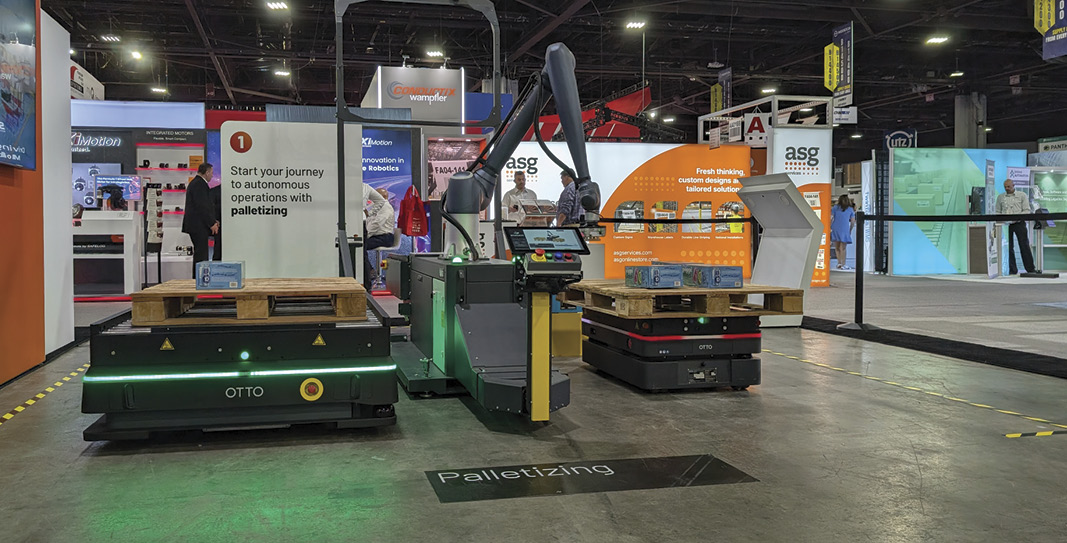
Seth Carlson, commercial manager of autonomous mobile robots (AMRs) at Rockwell Automation, highlighted during MODEX 2026 the importance of space utilization in production facilities, specifically when it comes to moving a product from one location to another.
“About 25 per cent of the workforce is dedicated to moving things from point A to point B,” Carlson said. “About 55 per cent of the space — which we know is very valuable — is also dedicated to moving things. And the biggest number: 87 per cent of the time in a production facility is spent moving things from point A to point B.”
Carlson said there are three primary challenges he sees within today’s production facilities that hinder efficient movement and space utilization.
The first is what he called siloed processes and systems, referred to as “islands of automation.”
“You walk into a facility and see high-end, expensive equipment spaced apart. Each piece works well on its own, but then you have people manually moving materials between them,” he said. “These islands are great individually, but they don’t solve the full problem.”
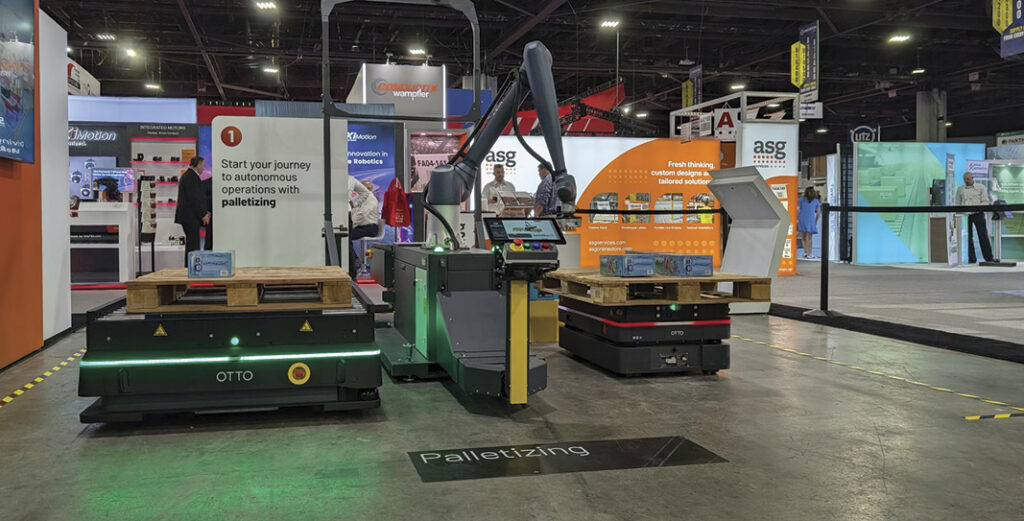
The second issue Carlson sees is the constant need to change how material is moved due to customers demanding greater flexibility. This often leads to frequent changes in production lines, with facilities struggling to adapt.
The third challenge, Carlson said, is inefficient workflows.
“You’ve all seen people pushing around empty carts or pallets,” he said. “I’ll ask the question I’ll repeat throughout this talk: Do you want to pay someone to push empty carts? The answer is no.”
Carlson said companies must employ what he called “production logistics” to help alleviate these challenges and improve space utilization within a facility.
“Production logistics is end-to-end autonomous operations that manage automated processes using data-driven insights to enable continuous optimization,” said Carlson, underscoring the words “autonomous” and “continuous.”
“If we want true, end-to-end production logistics, it has to be both autonomous and continuous.”
To achieve production logistics, Carlson said companies must consider five key factors: AMRs, autonomous systems and devices, orchestration, data analytics and simulation and emulation.
The first phase is to implement AMRs, followed by orchestration, where the system automatically dispatches AMRs based on signals from systems such as warehouse management systems.
Carlson also emphasized the importance of data moving beyond simple dashboards to real-time intelligence, the role of simulation in successful deployment and ultimately eliminating wasted motion.
“One of the things we’re trying to eliminate was people walking,” he said. “No one’s carrying around empty carts.”
Avoiding unnecessary complexity in warehouse automation
Damian Nolazco believes complexity is the main barrier to the successful deployment of warehouse automation.
“Sometimes people assume that if a problem is complex, the solution must also be complex. But that is not always true,” said Nolazco, director of project engineering at Exotec. “While I’m passionate about advanced technologies like drones or humanoid robots in warehouses, unnecessary complexity can introduce risk into your business.”
Nolazco said complexity stems from more than the use of advanced robotics; it also comes from not understanding customer needs and current operations, poorly defined responsibilities between technology layers and facility constraints such as space or layout limitations.
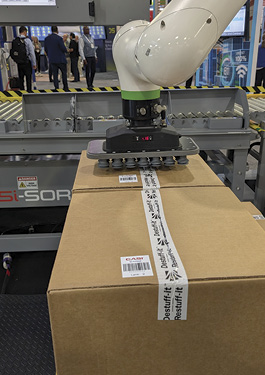
Some of the issues that lead to avoidable complexity include too many technologies, which make integration difficult; a lack of ability to fully simulate systems before they are deployed; and trade-offs between functionality, reliability and timelines.
“Even when systems technically work, customers can still struggle operationally. Engineering teams may spend months or years designing systems, but operators often only have weeks to learn them, sometimes relying on hundreds of pages of documentation,” said Nolazco.
“I have seen cases where solutions perform as designed but still create operational bottlenecks.”
Nolazco said complex problems require simple, structured solutions.
“Our approach is modularization,” he said. “We cannot solve every problem with one rigid system, but we can standardize modules while allowing customization where needed.”
Nolazco said the power of conformity across a network will enable faster expansion, lower business risk, a better operator experience and easier maintenance and scaling.
“This modular approach allows us to reuse solutions across different sites and even across different customers, accelerating learning and improving performance over time,” he said.
For Nolazco, the three key factors for the successful deployment of warehouse automation are understanding that bespoke does not always mean better, standardization does not mean one size fits all and modularization enables both consistency and customization.
Lift truck technology
As warehouse space continues to grow, it is estimated that 80 to 100 lift trucks are needed for every one million square feet of space added.
“That also means finding people to operate those trucks, which is increasingly difficult,” said Kyle Smart, sales manager for automation at Yale Lift Truck Technologies. “In many cases, companies are hiring whoever they can, which contributes to safety concerns.”
Because of this, Smart said automation has become a key solution, and he addressed three common concerns when it comes to implementing autonomous lift trucks: complexity, reliability and cost.
“Complexity often comes from the time and effort required to implement automation, as well as the difficulty of modifying systems once they are deployed,” he said. “Many solutions depend on specialized labour — software engineers and programmers — which is a shrinking talent pool.”
When it comes to reliability, Smart said customers expect systems to perform as advertised, and when issues arise, they must be resolved quickly.
“Reliability is addressed through strong service networks, local support and consistent manufacturing quality,” he said. “As companies scale automation, repeatability and long-term stability become critical.”
Cost is another hurdle, and not just the upfront investment.
“It’s also about building a confident business case,” said Smart. “Many automation decisions are based on simulations or assumptions, which don’t always match real-world conditions.”
Smart said there are four automation categories companies can evaluate when it comes to lift trucks: OEM-provided automation, AMRs, technology layered onto standard lift truck chassis and purpose-built automation vehicles.
Companies should consider their environment and use cases when determining which option works best, such as floor conditions, the presence of water or washdown processes and temperature variations across work zones.
“Standing water can interfere with safety sensors, causing false positives or affecting stopping distances,” said Smart. “Similarly, moving between temperature zones can cause condensation on sensors, leading to inefficiencies.”
From a use-case perspective, repetitive, horizontal transport tasks, like waste handling, finished goods transport and raw material movement, should all be examined.
“Ultimately, the key takeaway is that automation is not a one-time implementation,” said Smart. “Workflows will change, and systems must adapt accordingly.”




Leave a Reply