Why airflow design is becoming essential in Canada’s modern warehouses
Share

Share
Several factors are influencing how the modern Canadian warehouse is designed. From record-breaking heat and volatile energy prices to a tightening labour market facing “thermal fatigue,” today’s warehouses are larger, taller and more automated than ever.
As warehouses span 25,000-500,000 square feet with ceiling heights reaching more than 20 feet, leaders face new challenges in re-engineering the adaptive warehouse.
In the absence of proper airflow circulation, warehouse ceilings can reach 40 to 50 C while floor temperatures sit 10 to 15 degrees cooler.
Airflow systems in today’s warehouse are no longer seen as a luxury add-on, but rather a necessary part of the blueprint.
In the past, full air conditioning using traditional HVAC systems was avoided mainly due to cost, and warehouses relied primarily on passive ventilation. But now, as warehouses must overcome new hurdles such as tightening worker safety regulations, labour retention, autonomous equipment requiring consistent thermal conditions and mitigating condensation to reduce spoilage, high-volume, low-speed (HVLS) fans are an energy-efficient way to manage costs while delivering results.
“Large-diameter ceiling fans are increasingly used in warehouses to move massive volumes of air at low rotational speeds,” said Nick Georgescu, marketing manager, Canada, for Big Ass Fans.
“Rather than cooling air through refrigeration, these systems create constant, gentle airflow across worker zones, improving thermal comfort through evaporative cooling and air destratification.”
– Nick Georgescu, marketing manager, Canada, for Big Ass Fans
Redistributing trapped heat with an HVLS airflow system provides a viable alternative to mechanical cooling — often expensive and impractical — and helps reduce heating energy consumption by eliminating temperature gradients inside large warehouses.
“Because airflow enhances thermal comfort without the need for costly mechanical cooling, it has become one of the highest ROI components of a facility strategy; especially when accounting for destratification benefits and energy rebates,” said Georgescu. “The result is savings up to 30 per cent on energy costs year-round, along with correlated benefits in increasing productivity, reducing employee turnover and reducing downtime.”
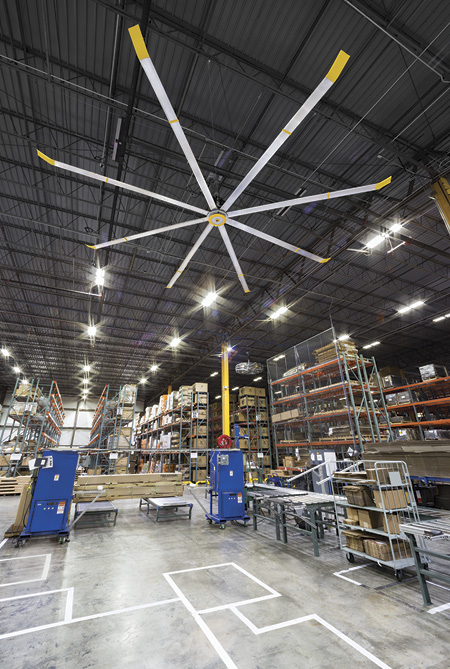
In addition to lower energy consumption, benefits of HVLS ceiling fans include redistributing trapped hot air near ceilings, improved ventilation and humidity dispersion. Though they do not cool the air, HVLS fans provide a perceived cooling effect, helping workers feel 4 to 7 C cooler, or, when paired with evaporative coolers, can achieve a cooling effect of up to 18 C.
“Because of their ability to circulate air efficiently across expansive footprints, HVLS fans are considered the foundation of industrial airflow strategies, especially in logistics buildings with ceiling heights ranging from 20 to over 80 feet,” said Georgescu.
Developers are also adopting several complementary approaches to HVLS systems to manage rising temperatures within warehouses. Some of those options include reflective cool roof systems, rooftop solar installations, smart ventilation systems and environmental monitoring that allows operators to adjust airflow when needed.
Today’s automation systems — autonomous mobile robots (AMRs), automated storage and retrieval systems (AS/RS) and conveyor networks — contribute to the generation of heat. Airflow systems such as those from Big Ass Fans can integrate with warehouse management systems (WMS) or building automation systems (BAS) and automation platforms to ensure worker comfort and equipment reliability.
The future of warehouse airflow
Several trends will reshape how warehouses are planned and designed across Canada, from energy efficiency and climate resilience to incentive programs and worker comfort.
“As labour shortages persist in logistics and warehousing, companies are increasingly prioritizing workplace conditions that improve employee retention, safety and productivity,” said Georgescu, adding that rising energy costs also lead to companies leveraging government rebates to help mitigate those costs. “Indoor environmental quality—including airflow, temperature stability and air movement—is becoming an important factor in creating facilities where workers can sustain performance throughout long shifts.
“Thermal fatigue” has a measurable impact on labour productivity in warehouses. Research has shown that up to 60 per cent of workers experience productivity loss when exposed to temperatures above 28 C. When those temperatures exceed 32 C, worker productivity declines by up to 20 per cent, and as much as 50 per cent in physically demanding conditions.
This is why warehouses must aim to be climate-resilient, as frequent heat waves make working conditions more challenging during extreme weather events. Prioritizing technology that reduces heating and cooling energy demand while maintaining operational reliability is another trend moving forward — an area where airflow systems play a key role by redistributing heat and reducing dependence on mechanical cooling.
Retrofitting HVLS fans into older warehouses with 20- to 50-foot ceilings allows for a high-impact upgrade with minimal disruption to daily workflows. This shift not only solves airflow issues but also introduces modernization and efficiency benefits, effectively future-proofing older industrial assets.
“Within this evolving landscape, airflow management is increasingly being treated as a foundational layer of warehouse infrastructure,” said Georgescu. “For developers competing for tenants like Amazon, TJX Group and major 3PLs, thermal conditions have become a leasing differentiator.”


Leave a Reply