
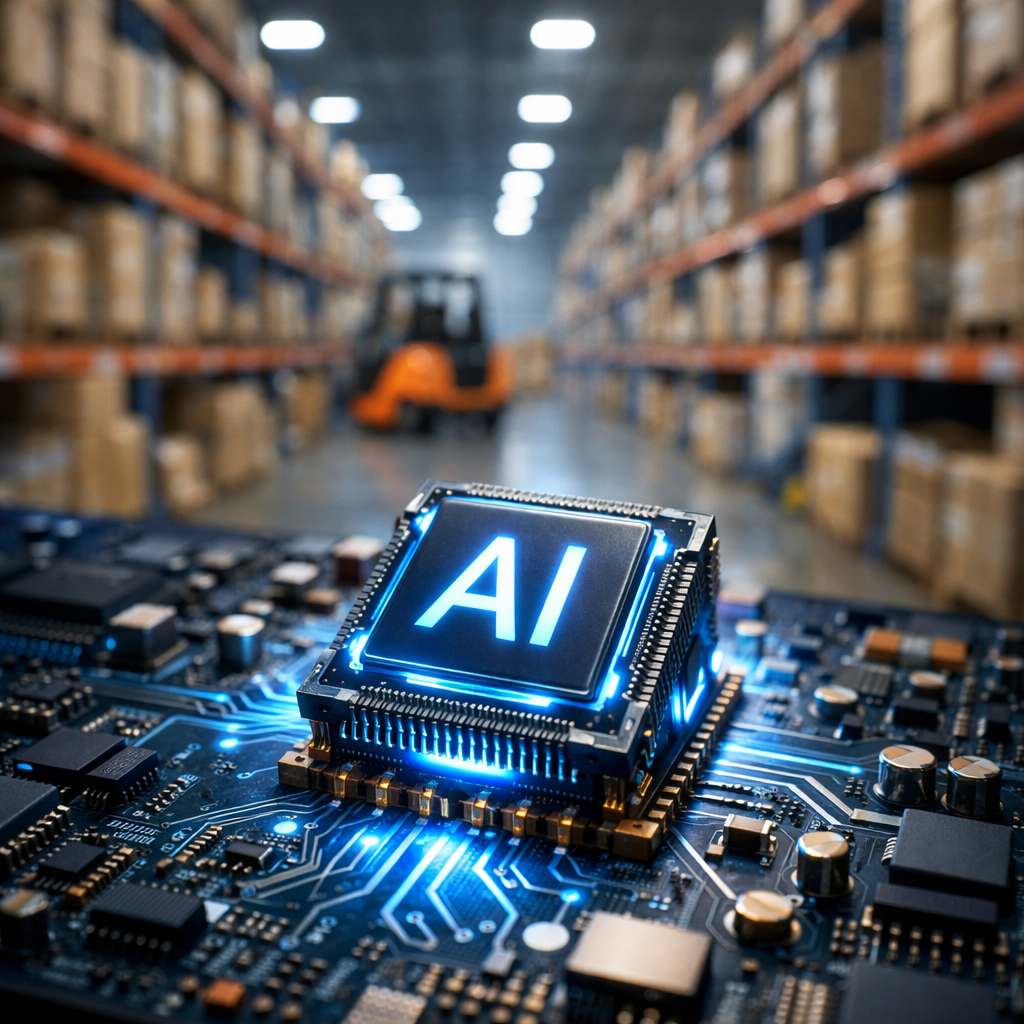
 For years, artificial intelligence has been treated as either a futuristic promise or an abstract buzzword in supply chain discussions. Today, that’s changing. AI is no longer about replacing people or building science-fiction control towers — it’s about giving supply chain professionals better tools to make faster, more informed decisions in an environment defined by constant disruption.
From forecasting volatility to day-to-day execution, AI is quietly becoming one of the most useful enablers in the supply chain toolkit.
Supply chains generate massive amounts of data: forecasts, purchase orders, shipment milestones, inventory levels, carrier performance and customer demand signals. The challenge has never been a lack of data; it’s the ability to interpret it quickly and accurately.
AI excels at identifying patterns humans would struggle to see across thousands of data points. Machine-learning models can analyze historical trends alongside real-time inputs like weather, port congestion, labour availability or sales velocity. Instead of static reports that are already outdated when they’re opened, AI can identify dynamic insights that help teams anticipate issues before they escalate.
For planners, this means demand forecasts that continuously adapt rather than relying on fixed assumptions. For operations teams, it means earlier alerts when service failures or bottlenecks are likely to occur. Traditional forecasting methods depend heavily on historical data, but in recent years, after experiencing pandemics, geopolitical conflict, inflation and intensifying climate events, history has become a less reliable predictor of the future.
AI-driven forecasting tools can incorporate a wider range of variables and adjust forecasts more frequently as they learn over time, improving accuracy as new data becomes available. This doesn’t eliminate uncertainty, but it helps reduce the margin of error and gives teams more confidence when making decisions around production, inventory and transportation.
More importantly, AI allows supply chain leaders to run scenario planning at scale. What happens if demand spikes in one region? If a supplier goes offline? If transit times extend by five days? AI makes it possible to evaluate multiple “what-if” scenarios quickly and choose the least disruptive path forward.
Visibility is often described as the holy grail of supply chain management, but visibility alone isn’t enough. What matters is knowing where to focus attention.
AI helps supply chain professionals identify that focus by prioritizing exceptions instead of flooding teams with alerts. Rather than flagging every late shipment, AI can identify which delays will have the greatest downstream impact on customers, costs or service levels. This allows teams to shift from reactive firefighting to proactive problem-solving.
In transportation, AI can recommend alternate routes or carriers when disruptions occur. In warehousing, it can optimize slotting, labour allocation and picking paths to improve efficiency. These improvements may seem incremental, but over time they compound into significant gains.
One of the biggest misconceptions about AI is that it replaces human expertise. In reality, the most effective AI applications are decision-support tools.
Supply chain professionals bring context, experience and judgment that AI cannot replicate. AI provides speed, pattern recognition and consistency. Together, they create a stronger decision-making process.
For example, an AI system might suggest reducing inventory in a specific lane based on demand signals. A planner can then apply their knowledge of upcoming promotions, supplier reliability or customer expectations before acting. The result is a more informed decision, not an automated one.
AI can also act as a bridge between traditionally siloed functions. When forecasting, procurement, logistics and sales teams are working from the same AI-driven insights, conversations become more aligned and less reactive.
Anyone who worked in supply chain over the past five years knows how quickly plans can unravel. Spreadsheets built on last quarter’s assumptions don’t survive a port strike, a weather event or a supplier shutdown. AI doesn’t prevent those disruptions, but it does shorten the time between realizing something is wrong and understanding what can be done about it.
Shared visibility and common data models reduce finger-pointing and improve accountability. Instead of debating whose numbers are correct, teams can focus on how to respond collectively to emerging risks and opportunities.
Historically, advanced analytics required specialized skills, long implementation timelines and significant investment. Today, AI-powered tools are increasingly accessible through user-friendly platforms.
Natural language interfaces allow users to ask questions in plain language — “Which suppliers are driving late deliveries this quarter?” — and receive actionable answers. This democratization of analytics empowers more people across the organization to engage with data, not just data scientists.
This does not mean AI will eliminate disruption from the supply chain, but it will influence how quickly and effectively organizations respond to that disruption.
Companies that adopt AI as a practical enabler, focused on improving visibility, decision-making and collaboration, will be better positioned to manage volatility. Those that wait for a perfect, fully autonomous solution may find themselves perpetually behind.
The future of the supply chain isn’t human versus machine; it’s humans augmented by intelligent tools, making smarter decisions in real time. And that future is already here.




Leave a Reply