Moving high-value equipment requires more than careful handling
Share

Share
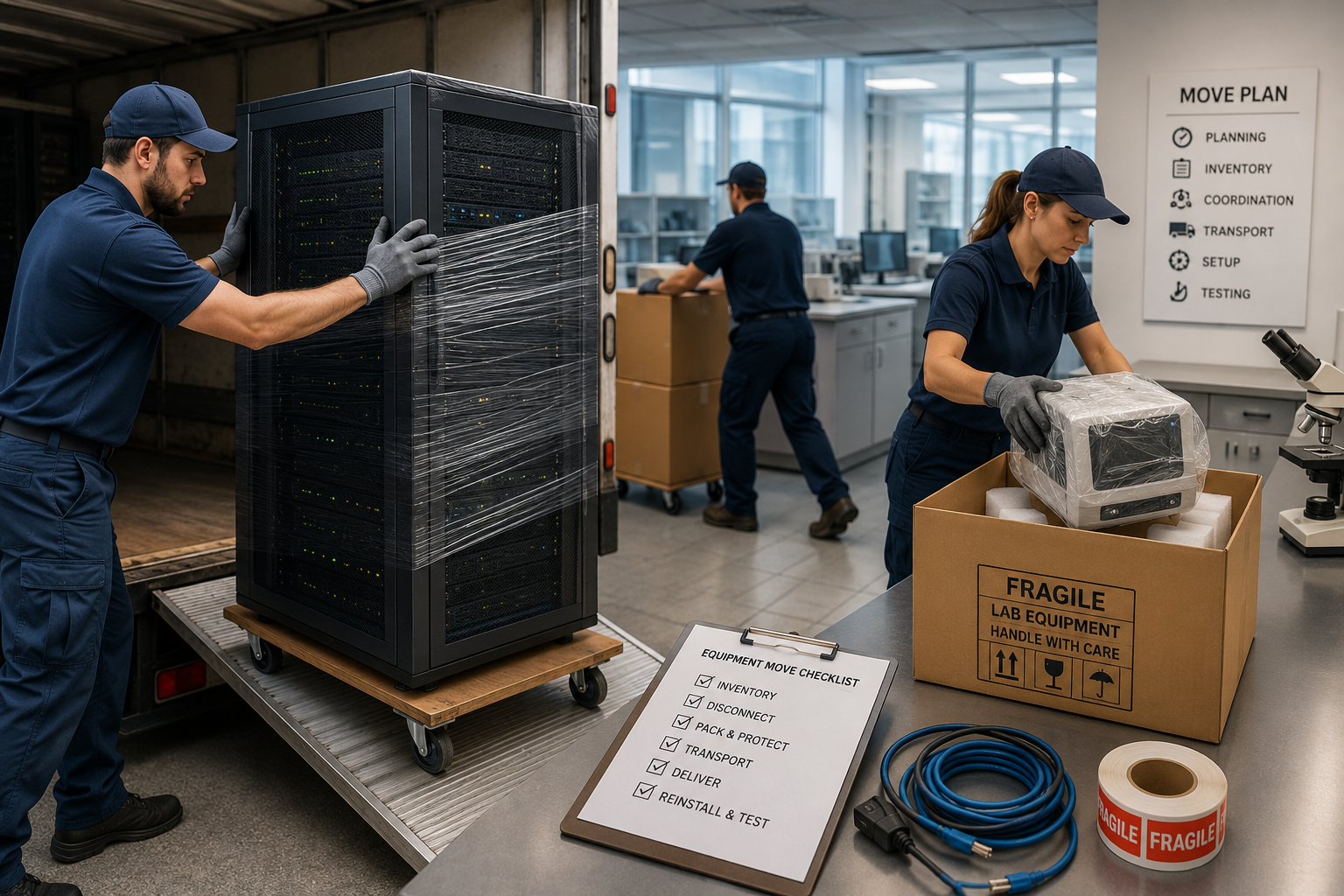
In many office moves, the most expensive items are not the largest. A server cabinet, diagnostic instrument, microscope, testing device or calibrated lab system may take less space than a boardroom table, but carry far greater operational risk.
If a desk is damaged, the problem is visible and usually replaceable. If server gear is mishandled, a company may lose access to systems, files, client records or internal applications. If lab equipment is moved without the right preparation, the result may be a failed calibration, delayed testing, damaged components or interrupted research.
That is why high-value equipment relocation sits in a different category from general office moving. It is not only a labour and transport task. It is a continuity exercise involving logistics, facilities, IT, risk management and technical handoff.
Dmitrii Malashkin, founder of the U.S.-based moving and logistics company Born to Move, has seen this shift from the commercial relocation side. As companies change offices, consolidate spaces or move between states, the items that require the most planning are often the ones that cannot simply be wrapped, loaded and reinstalled the next morning.
For logistics managers and operations teams, the practical lesson is straightforward: server gear and lab equipment should be planned around as operational assets, not ordinary office contents.
The hidden risk in technical office moves
Traditional office moves are often scoped by volume, distance, access and labour hours. High-value logistics adds a second layer of questions.
What equipment is business-critical? Who is authorized to disconnect it? Can it be moved while assembled? Does it need anti-static handling? Is it temperature-sensitive? Does it contain data-bearing hardware? Has it been calibrated? Does it require recommissioning after delivery? Who signs off when it leaves one site and arrives at the next?
Those questions matter because a physical relocation can affect more than the equipment itself. A server outage may interrupt operations. A misaligned lab instrument may produce unreliable results. A lost component may delay an entire department. A damaged testing device may create cost far beyond its replacement value.
For companies with IT rooms, laboratories, medical-adjacent equipment, quality-control stations or engineering tools, the move plan should begin with the assets that would hurt most if they were unavailable on Monday morning.
Start with an asset-level inventory
The first serious step is not packing. It is an inventory.
A high-value equipment move should begin with an asset-level list that includes serial numbers, model details, dimensions, weight, location, condition, value where relevant, and handling notes. For server gear, which may include rack position, cabling references, drive status and restart priority. For lab equipment, it may include calibration status, manufacturer requirements, removable parts, internal locks and whether the item has been cleared for safe handling.
This level of detail may feel slow at the beginning, but it reduces confusion later. It also creates a shared record between the client, logistics provider, IT department, lab manager and receiving team.
A broad label such as “electronics” or “lab equipment” is not enough. A microscope, centrifuge, analyser, server, backup unit and network switch do not carry the same handling profile. Each asset needs to be understood before a crew arrives.
Server gear requires technical handoff, not just transport
Server relocation is one of the clearest examples of why high-value logistics cannot be treated as furniture moving.
The physical equipment may be sturdy in normal use, but vulnerable during transfer. Servers, switches, storage arrays, backup units and associated hardware can be affected by vibration, static discharge, poor packing, uncontrolled stacking, moisture exposure or incomplete documentation.
Before the move, the client’s IT team should confirm backups, shutdown sequence, cable mapping, rack diagrams, equipment labels and restart priorities. The logistics provider should understand which items are to be moved racked, which are to be de-racked, which require padded crates, which need anti-static materials and which should remain under the direct control of the internal IT team.
Data-bearing devices require particular care. The moving provider may be responsible for physical custody, but the client remains responsible for data governance. Drives, backup media and sensitive hardware should be assigned a clear custody protocol before the move. In some cases, those items should travel separately from general office contents.
For larger relocations, the move schedule should also be built around the IT cutover. The goal is not simply to deliver server equipment. The goal is to help the client resume operations within the planned restart window.
Lab equipment adds calibration, safety and validation issues
Laboratory equipment introduces another set of risks. Some items are sensitive to shock, vibration, tilt, temperature or humidity. Others include internal components that must be locked, removed or secured before transport. Some require manufacturer instructions or technician involvement before they can be safely moved.
There is also a safety boundary that should not be blurred. Moving crews should not be expected to handle chemicals, biological material, samples, residues or contaminated equipment unless the work has been properly cleared and assigned to qualified parties. The client should confirm cleaning, decontamination or preparation requirements before the logistics provider takes custody.
Calibration is another major issue. A piece of equipment may arrive without visible damage and still require inspection, recalibration or validation before it can return to use. For laboratories, quality-control departments or research environments, which can affect schedules, reporting and compliance.
A good relocation plan therefore separates physical delivery from operational readiness. The logistics provider can manage protection, lifting, loading, transport and placement. The client, manufacturer or technical specialist may still need to confirm that the equipment is ready for use.
The site survey must cover both locations
High-value equipment moves are often won or lost during the site survey.
At the origin, the team needs to understand access routes, door widths, elevator capacity, floor protection, loading dock rules, security restrictions and the order in which items must leave the space. At the destination, the same questions matter again. A receiving site that is not ready can create unnecessary handling, temporary staging or last-minute storage, all of which increase risk.
For server rooms and lab spaces, the receiving environment matters even more. Power, ventilation, benching, racks, network connections, clearance and security access should be checked before delivery. If the equipment arrives before the room is ready, the move becomes a storage problem.
Building rules can be just as important as the route. Commercial buildings may require certificates of insurance, elevator bookings, after-hours access, dock reservations and security lists. In dense urban markets, parking and loading time can become operational constraints. For interstate moves, delivery windows, secure stops, crew schedules and vehicle routing need to be planned in advance.
Chain of custody reduces confusion
Chain of custody is not only for pharmaceuticals, legal evidence or high-security freight. It is also useful for expensive technical assets.
A basic custody process records what was packed, when it was packed, who handled it, where it was loaded, how it was transported and who received it. For higher-value moves, photographs before packing and after delivery can help document condition.
This is especially useful when several parties are involved. An IT team may disconnect equipment. A lab manager may release instruments. A moving crew may pack and transport them. A facilities team may receive them. A technician may recommission them. Without documentation, it becomes difficult to know where responsibility passed from one party to another.
For clients, custody records also help with insurance and internal accountability. For logistics providers, they reduce disputes and create a clearer operating process.
Packaging should be designed around the equipment
High-value packing is not a matter of adding more material. It is a matter of using the right protection for the right risk.
Server equipment may require anti-static materials, foam protection, dedicated crates, cable labelling, rack stabilization and separation from liquids or heavy furniture. Lab instruments may require custom crating, internal component locks, removable-part packaging, shock indicators or manufacturer-guided handling.
The loading plan also matters. Sensitive equipment should not be buried under general office goods. It should not be placed where it can shift, absorb vibration unnecessarily, or be exposed to weather during loading. The crew should know which items are fragile, which are high value, which are priority delivery items and which require limited handling.
This is where experience with commercial and specialty relocations becomes important. Born to Move, for example, operates in local, interstate and specialty moving categories, including commercial relocations and the handling of equipment that requires more planning than standard household or office contents. Public FMCSA records list Born to Move LLC as an interstate household goods carrier under U.S. DOT #2887241.
For companies selecting a relocation provider, licensing is not the only factor, but it is a basic part of due diligence. So are insurance review, crew experience, documented process, access planning and the provider’s ability to explain how sensitive assets will be handled.
Downtime should be treated as a cost
In high-value logistics, the largest loss is not always physical damage. It may be downtime.
A server that arrives late can affect staff productivity, client service or internal systems. A lab instrument that requires unexpected recalibration can delay testing. A quality-control station that is not operational can hold up production decisions. A missing cable, bracket or component can stop a restart plan that looked simple on paper.
The move schedule should therefore be built backwards from the required return-to-service time.
Which systems need to operate first? Which items should be delivered first? Which equipment can be staged in advance? Which assets must remain in use until the final operating hour? Which technicians need to be on-site after delivery? What happens if the building is not ready?
This way of planning changes the conversation. The objective is not “complete the move.” The objective is “restore the function.”
Storage-in-transit needs stricter controls
Office relocations do not always move directly from one site to another. Lease dates, construction delays, network readiness or building access problems may create a gap. For ordinary furniture, storage-in-transit may be inconvenient. For servers and lab equipment, it can be a risk point.
Storage should be secure, clean, dry, inventoried and appropriate for the asset type. Sensitive electronics should not be stored near liquids, chemicals or heavy stacked goods. Lab equipment should be positioned correctly and protected from avoidable shock or environmental exposure. Access to stored equipment should be logged.
If storage might be needed, it should be discussed during planning, not improvised on the day of the move.
A practical control framework
For logistics and operations teams, the most useful approach is to turn risk into specific controls.
| Risk area | Why it matters | Practical control |
| Poor inventory | Items, parts or accessories may be lost or misidentified | Asset-level list with serial numbers, photos and labels |
| Server downtime | Systems may not restart within the planned window | IT cutover plan, backup confirmation and restart sequence |
| Data-bearing hardware | Physical custody may create governance risk | Clear custody protocol and separate handling where required |
| Calibration loss | Lab results or testing schedules may be affected | Pre-move status record and post-move recalibration plan |
| Unsafe lab handoff | Crews may be exposed to materials they should not handle | Client-led cleaning, clearance and safety confirmation |
| Access failure | Equipment may not fit through routes or elevators | Origin and destination surveys with measurements |
| Improvised storage | Sensitive assets may be exposed to unsuitable conditions | Planned storage-in-transit controls and inventory logs |
| Insurance gaps | Replacement value may not reflect operational impact | Coverage review before move day |
This framework does not eliminate risk, but it makes the risk visible. That is the difference between a general move plan and a high-value logistics plan.
The role of the logistics provider
The logistics provider does not replace the client’s IT department, lab manager or equipment manufacturer. Its role is different: to plan the physical transfer, protect the assets, manage labour, control transport conditions, document custody and coordinate timing.
That requires a different kind of conversation between client and mover. The client should be ready to explain what the equipment does, what can go wrong, who has authority over it, and what must happen before it can be moved. The logistics provider should be ready to explain how it will protect the equipment, assign crews, control loading, document condition and manage delivery.
Born to Move’s growth from the Greater Boston market into broader U.S. service areas reflects a wider pattern among independent moving companies that have expanded from residential moving into more complex commercial and specialty work. That kind of work depends less on volume alone and more on process, training, documentation and the ability to coordinate with multiple stakeholders.
Treat the move as a continuity project
High-value office relocation is often underestimated because it still looks like a move. There are boxes, crews, vehicles and loading docks. But the real work is the protection of business function.
For server gear, which means preserving systems, custody and restart timing. For lab equipment, it means protecting calibration, safety and operational readiness. For logistics teams, it means planning around risk rather than reacting to it.
The safest mindset is to treat the relocation as a business continuity project with a logistics component. The truck matters. The crew matters. But the planning discipline around the assets matters more.
When high-value equipment is involved, successful delivery is not measured only by whether everything arrives. It is measured by whether the organization can return to work without avoidable delay, damage or uncertainty.





Leave a Reply