Global air cargo demand falls in March amid Middle East disruptions: IATA
Share

Share
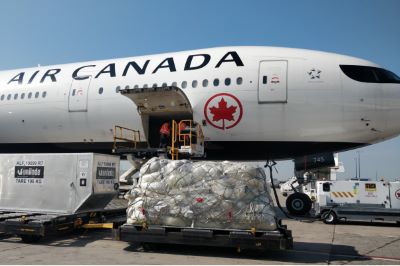
Global air cargo demand fell in March as conflict-related disruptions in the Middle East and seasonal factors weighed on volumes, according to the International Air Transport Association (IATA).
IATA said total demand, measured in cargo tonne-kilometres, declined 4.8 per cent year-over-year in March, while international operations fell 5.5 per cent. Capacity, measured in available cargo tonne-kilometres, dropped 4.7 per cent overall and 6.8 per cent for international operations.
“The underlying demand trends, at this point, appear strong and the recent World Trade Organization and International Monetary Fund revisions to trade and GDP projections continue to see growth in 2026,” said Willie Walsh, IATA’s director general. “Importantly, air cargo networks are providing the flexibility needed to support global supply chains as they adjust to geopolitical, tariff and operational strains. All eyes are on fuel supply and price, which are expected to test the industry’s resilience in the coming months.”
Despite the decline, IATA pointed to continued strength in broader economic indicators. Global industrial production rose 3.1 per cent year-over-year in February, marking the 38th consecutive month of expansion, while global goods trade increased eight per cent.
Manufacturing sentiment also remained in expansion territory in March, with the Purchasing Managers’ Index at 51.4 and the index for new export orders at 50.1.
Fuel costs, however, rose sharply during the month. Jet fuel prices increased 106.6 per cent year-over-year, while crude oil prices rose 43.1 per cent and refining margins surged 320 per cent.
Regional results were mixed.
Asia-Pacific airlines posted a 5.4 per cent increase in air cargo demand in March, while African carriers recorded the strongest growth at seven per cent. European carriers reported a 2.2 per cent increase, while Latin American and Caribbean carriers saw demand rise 1.8 per cent.
North American carriers reported a 1.2 per cent decline in demand.
Middle Eastern carriers posted the steepest drop, with demand falling 54.3 per cent and capacity down 52.4 per cent, the weakest performance of any region.
Trade lane performance also varied, with Africa-Asia and Asia-Europe leading growth, while intra-Asia trade remained resilient. IATA said corridors linked to the Gulf were heavily affected by the ongoing conflict in the Middle East.

Leave a Reply