From promises to purchases, a sustainability plan is an ongoing commitment with multiple benefits
Share

Share

A meaningful sustainability policy can change the way an organization makes purchases, how it orders products and how suppliers are held accountable.
Minto Roy is the co-founder and managing partner of Social Print Paper, a B.C. company that helps businesses reduce their carbon footprint when it comes to paper use. Roy believes companies need to eliminate the gap between their public commitments and their everyday procurement decisions — and that supply chain leaders have the ability to close it.
“You want to operationalize policy. You want to be able to measure it, you want to report it, you want to be able to scale it,” said Roy. “By creating accountability and reporting, you operationalize policy.”
Developing a policy and awarding a contract with sustainability as a criterion is only the beginning, and Roy says organizations must follow through with implementation, sustainability measurement, reporting and expansion.
This, Roy believes, is how a sustainability commitment can have a real impact on the thousands of individual purchases a company makes.
Procurement channels
The roles of supply chain and procurement teams are essential to the success of any company’s sustainability goals.
It’s through these partnerships that products enter a company’s network and have a direct impact on its environmental objectives, making the role of supply chain leaders that much more essential to the success of a sustainability plan.
Supplier accountability also doesn’t end once the contract is awarded.
Roy says some suppliers will offer sustainable products during a competitive bid and argues that organizations should require ongoing reporting on how they are advancing policy objectives.
“By creating accountability and reporting, you operationalize policy,” he said.
Roy also believes there is a connection between environmental and commercial benefits. He suggests finding sustainable alternatives that preserve product performance and avoid workflow disruption or a premium price tag.
“Your ability to talk fluently about the sustainable procuring case as the business case is important,” he said. “How do you either make a company money or save a company money, and how do you create efficiencies that are measurable?”
Purchasing decisions should account for the total value of the product a company is sourcing, including carbon costs. This is where Roy believes companies miss significant cost savings beyond the actual purchase price.
Lower-emission products can reduce an organization’s expenditure on carbon offsets, and suppliers can demonstrate those savings as part of a purchasing proposal alongside other measurable benefits.
Department communication
Departmental silos are a challenge that can prevent an organization from realizing environmental and financial gains.
Roy says collaboration between procurement, sustainability and finance departments is key to finding opportunities to reduce both emissions and expenditures.
“How can we converge if we don’t have any communication bridges?” he said. “We don’t have any relationships to drive that collaboration. This is a compartmentalization problem.”
Changing climate
Advocacy for sustainability and environmental, social and governance (ESG) policies has become quieter over the past few years. But Roy believes that values become more meaningful when acting on them is difficult.
“We want to make money. We want to be competitively advanced,” he said. “All can exist. How do you compellingly create a business case that’s both a competitive advantage and a competitive threat, if not integrated?”
Part of the challenge of making these difficult decisions is reaching beyond those who already agree with your position. “These conferences are often echo chambers of affirmation and confirmation,” he said. “How do I relate out there?”
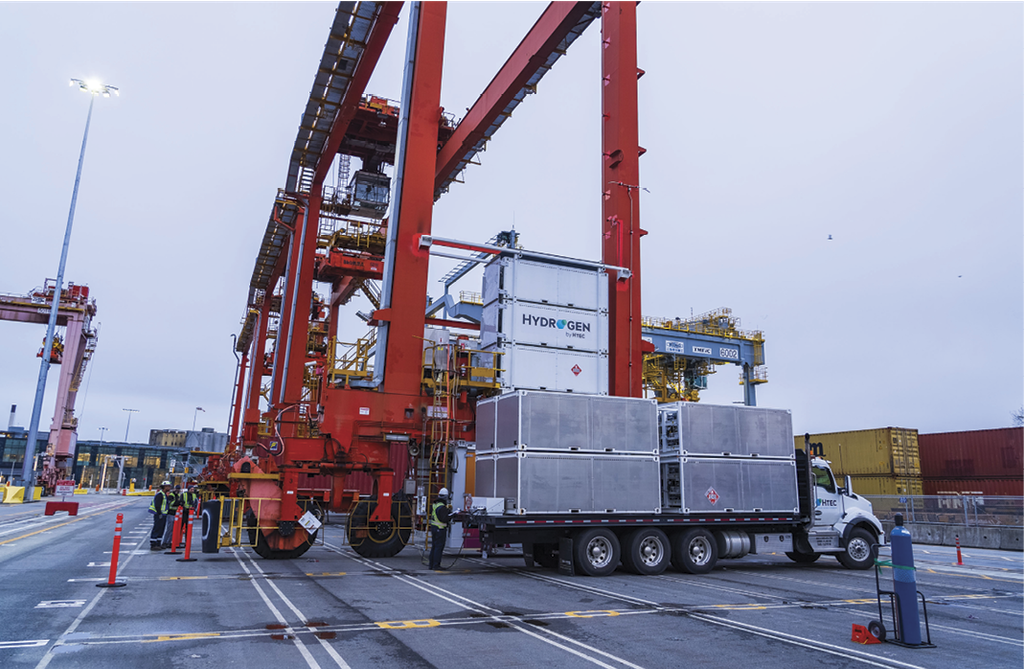
The Port of Vancouver was the site of DP World’s pilot project involving a hydrogen fuel cell rubber-tired gantry (RTG) crane — the first hydrogen-electric RTG in Canada and the first retrofitted unit of its kind globally.
In April of last year, DP World successfully completed initial testing of its hydrogen fuel cell RTG crane at the Port of Vancouver, marking a significant milestone in decarbonizing its port operations. The crane then underwent field testing to assess the feasibility of electrifying the company’s global fleet of 1,500 RTG cranes. The pilot launched in October 2023.
“As one of the world’s foremost port and terminal operators, we are dedicated to advancing sustainable practices that will drive industry-wide change,” Doug Smith, CEO of DP World in Canada, said at the time. “This pilot not only marks an important step in DP World’s commitment to decarbonizing its operations, but it also sets a new benchmark in sustainable logistics. Real-world testing ensures our solutions are reliable and effective and could open the door to electrifying our global fleet of RTGs.”
But there are some practical hurdles to decarbonizing port operations.
During the Canadian Hydrogen Convention in Edmonton last year, Bronwyn Pountney, environmental manager with DP World Canada, provided an update on the project and highlighted some of the challenges the company encountered, including barriers to wider adoption. The most consequential outcome was the determination that DP World would not be looking to scale the solution further at this time.
Pountney said that despite this decision, the pilot provided real-world data and insights that will help guide the company’s decisions as the technology and market evolve.
“Ultimately, this was about testing what was possible in a real operating environment,” she said.
Hurdles to overcome
Traditionally powered by diesel, RTG cranes are essential for cargo handling but are significant contributors to greenhouse gas emissions. At DP World’s Vancouver terminal, 19 RTG cranes account for 50 per cent of diesel consumption and generate more than 4,200 tonnes of carbon dioxide annually. The adoption of hydrogen technology promises to dramatically reduce or even eliminate this impact.
But the cost of hydrogen was one of the major obstacles to decarbonization. In DP World’s operating context, hydrogen was approximately four to five times more expensive than diesel.
Supply was another concern.
“One of our biggest challenges that we encountered was around supply, so both the availability and the reliability in our port environment,” said Pountney. “It points to the need for localized supply solutions and a more phased approach to infrastructure development.”
Refuelling was another challenge, often interfering with the terminal’s core operations. As Pountney pointed out, hydrogen refuelling takes approximately an hour, compared with around 15 minutes for the diesel equivalent. The process also requires a safety exclusion area, which changes traffic movements within the terminal.
“When you need to cordon off a large part of the terminal to refuel, it basically means you have to reroute everything around that,” said Pountney.
There was also a need to prepare staff for the transition to a hydrogen-based system and its workflow. This included training terminal staff, securing buy-in from longshore workers, developing procedures and adjusting how tasks were performed.
As with any emerging technology, there was also a need to partner with outside organizations to assist with problems or training.
Benefits identified
Some of the benefits of the hydrogen fuel cell RTG crane pilot project include reduced spill risk, simpler maintenance and quieter operation.
“This has a simplified drivetrain, so there are fewer moving parts to improve reliability,” said Pountney, adding that the simpler operation also extended asset life.
Overall, Pountney said the trial helped DP World clarify where hydrogen might fit and where the technology needs to improve.
DP World partnered with TYCROP Manufacturing Ltd., H2 Portable and HTEC for this pioneering project. H2 Portable, together with TYCROP, designed a hydrogen-electric generator (HEG) using a dual fuel cell and battery energy storage system, while HTEC provided the hydrogen storage system and hydrogen supply.




Leave a Reply