Trucking and logistics employment outpaces broader labour market in May
Share

Share

Employment in Canada’s trucking and logistics sector grew faster than the overall labour market in May 2026, according to new data from Trucking HR Canada (THRC).
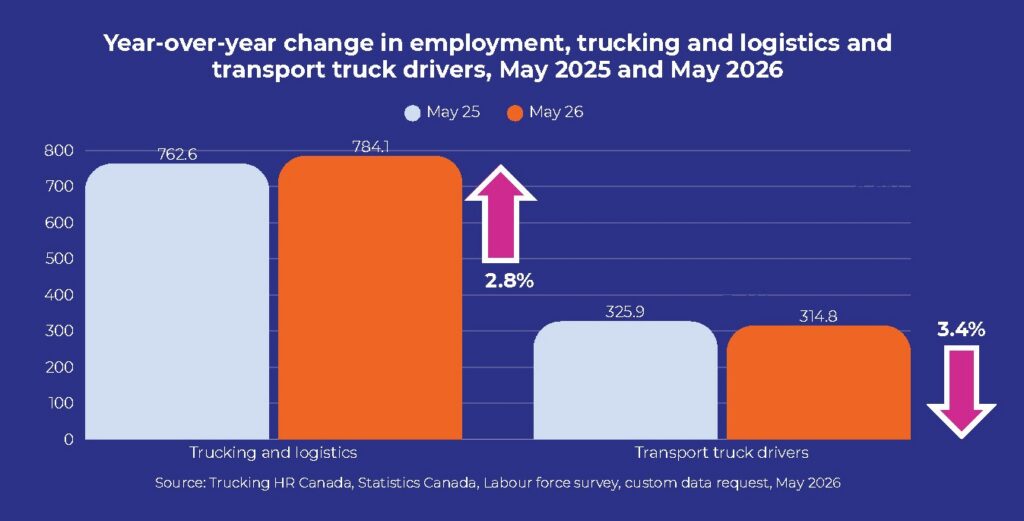
The sector added 21,500 jobs year-over-year, a 2.8 per cent increase compared with May 2025. THRC said trucking and logistics continues to act as a leading economic indicator and remains a key contributor to national employment growth.
Craig Faucette, chief operating officer at THRC, said the latest figures mark a shift from recent job-loss trends.
“Trucking and logistics contributed 33,500 jobs to national employment growth in May,” he said. “Within the sector job numbers, truck drivers surged by 17,800 jobs, or six per cent in May, compared to April. This is the first month-to-month increase in driver employment this year.”
Statistics Canada data showed construction led job creation in May, with transportation and warehousing tied for second alongside information, culture and recreation. THRC noted that about eight per cent of new jobs in construction were transport truck drivers, while wholesale trade lost nearly 4,600 jobs but still added 1,500 transport truck drivers.
THRC data also showed mixed year-over-year trends within the sector. Employment of truck drivers was down 3.4 per cent, or 11,100 jobs, compared with May 2025, despite broader sector gains.
Unemployment in trucking and logistics fell year-over-year, with 4,800 fewer workers seeking employment, a decline of 9.8 per cent. Among truck drivers, unemployment was down 6.8 per cent, with 1,500 fewer unemployed drivers actively looking for work.
The unemployment rate in the trucking and logistics sector fell from six per cent to 5.3 per cent year-over-year. For transport truck drivers, it declined from 6.4 per cent to 6.2 per cent. Across the broader Canadian labour market, the unemployment rate fell from seven per cent to 6.6 per cent.


Leave a Reply